

Back at the start of last month I embarked on an ambitious project: to attempt every single Workout Wednesday in chronological order. What is Workout Wednesday? Put simply, it's a set of weekly challenges designed to improve one's skills using Tableau, led in 2017 by Andy Kriebel and Emma Whyte from The Information Lab. They post a challenge, a few pointers to get you started, and their solution for those who get stuck (as you'll read below, I got stuck a lot).
I've completed twelve of these now, and I wanted to describe here what I've taken away from this, both in terms of what I've learned about Tableau as well as what I've learned about myself.
What I learned about Tableau
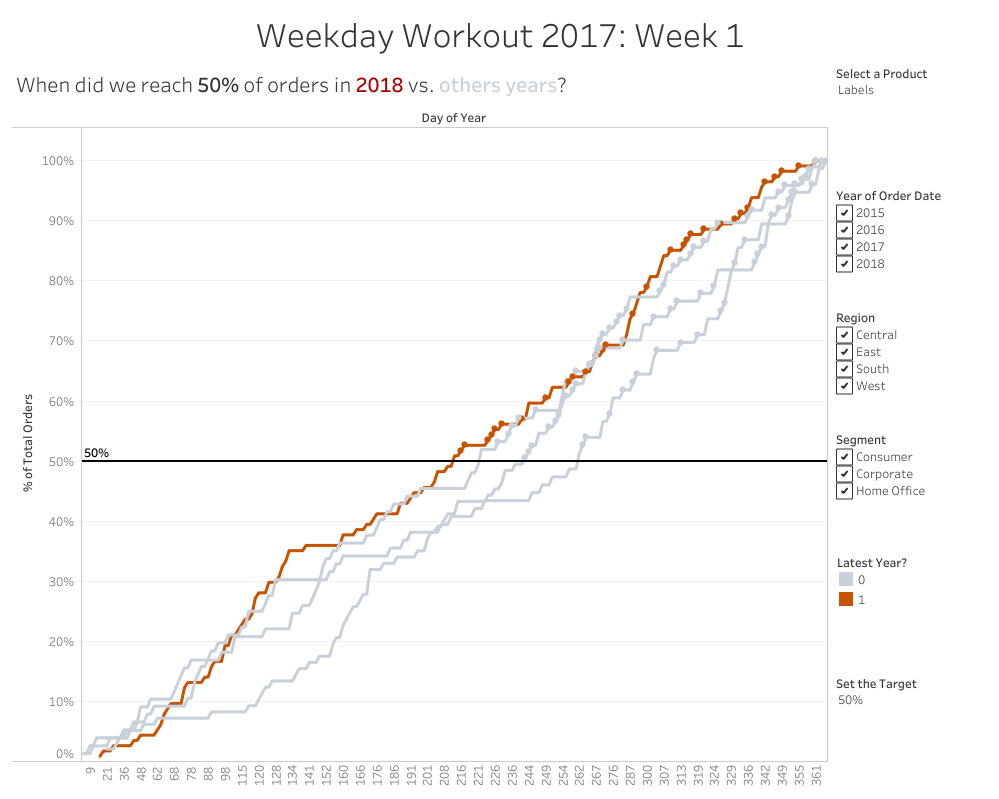
Comparing Year over Year Purchase Frequencies: I needed to derive the day of the year for this to work, and I started to use a fiddly DATEDIFF() calculation for it. No need! Instead, simply use DATEPART('dayofyear', [Date]) for the same end result.
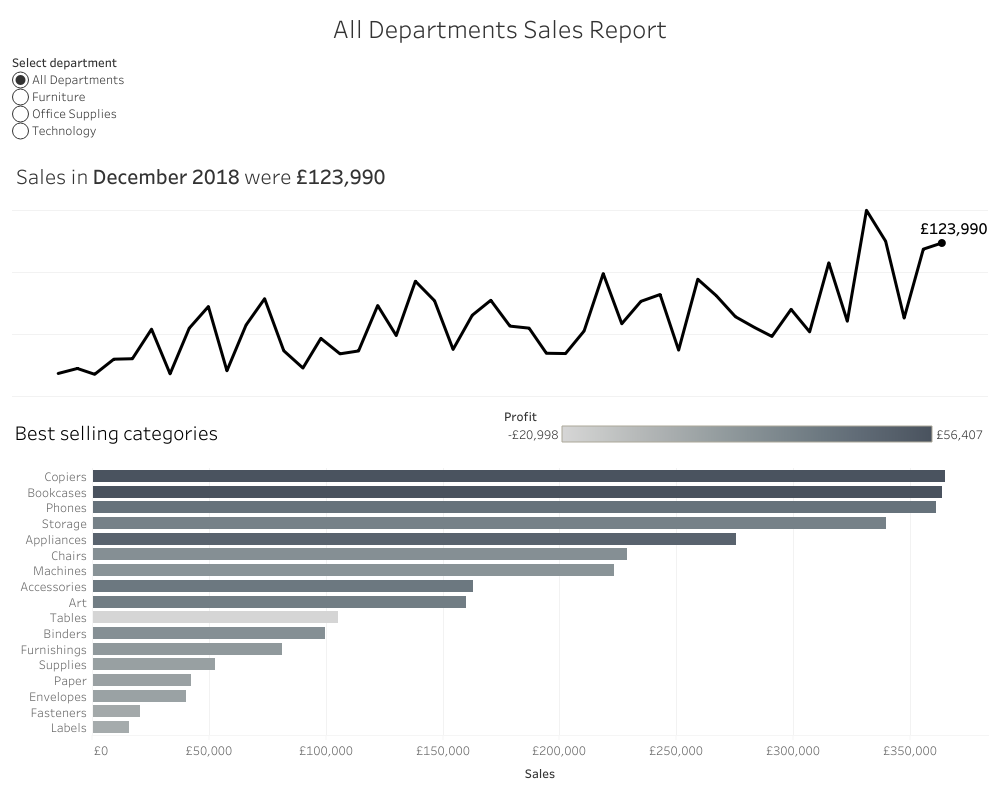
Showing Nothing When 'All' is Selected: on a conditional filter, you can display all values via "1=1". Makes perfect sense in retrospect, I suppose.
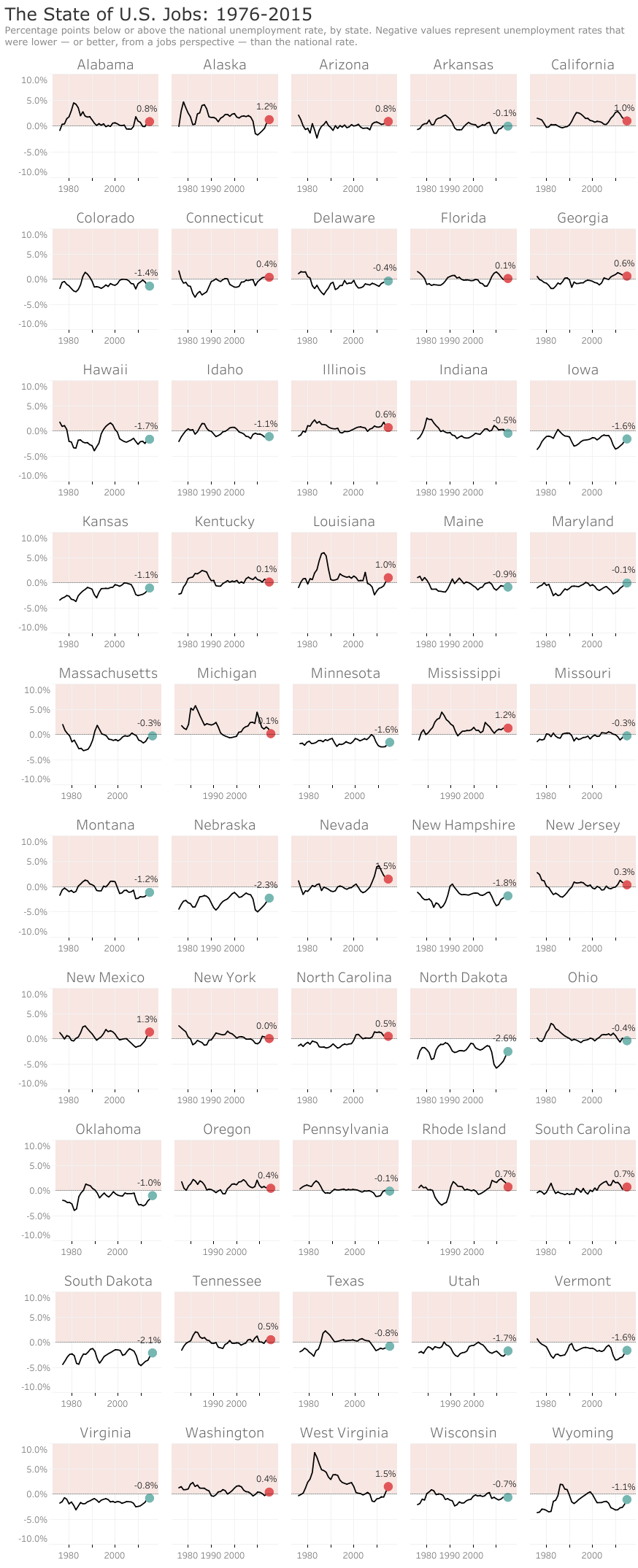
The State of U.S. Jobs: I was most pleased with this one, especially as it was a real struggle at first. I first made use of FIXED() for this challenge, as I needed to calculate a national average with a State filter applied. I hadn't researched the concept of Level of Detail (LoD) expressions at this point, so I treated FIXED() as just any other function.
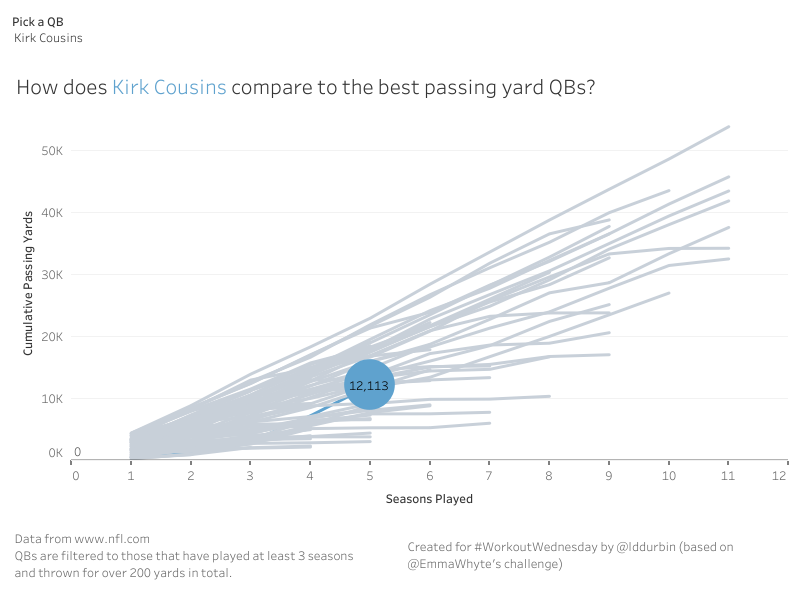
Common Baseline Charts & NFL QBs: I got to use Union to prepare the data - a process I usually do upfront via an ETL like Alteryx or EasyMorph (or even Tableau Prep these days). For something really simple like stacking a bunch of rows with common fields together, doing it here makes sense.
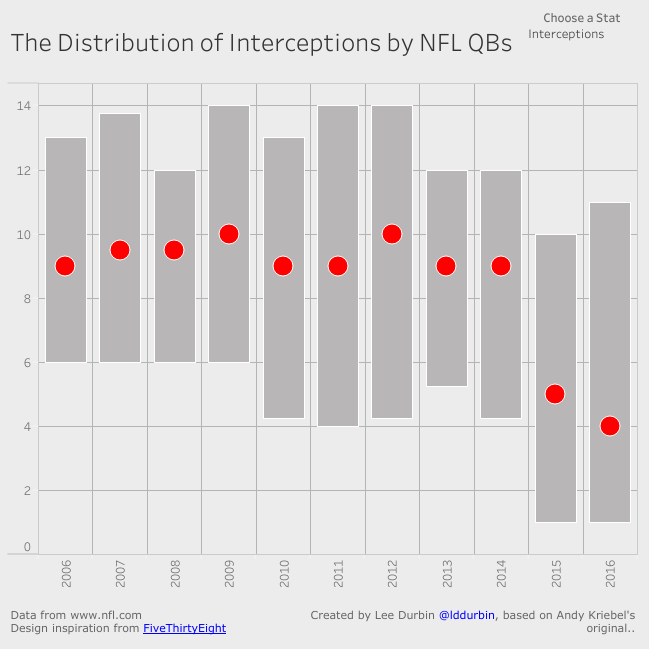
The Distribution and Mean of NFL Quarterbacks: although this one looks correct, the Tooltips aren't quite right because Players are included in the view when part of the challege was to avoid that. Checking Andy's version showed me that my lack of understanding about LoDs was holding me back, so I spent an hour or two over the following weekend reading up on the topic.
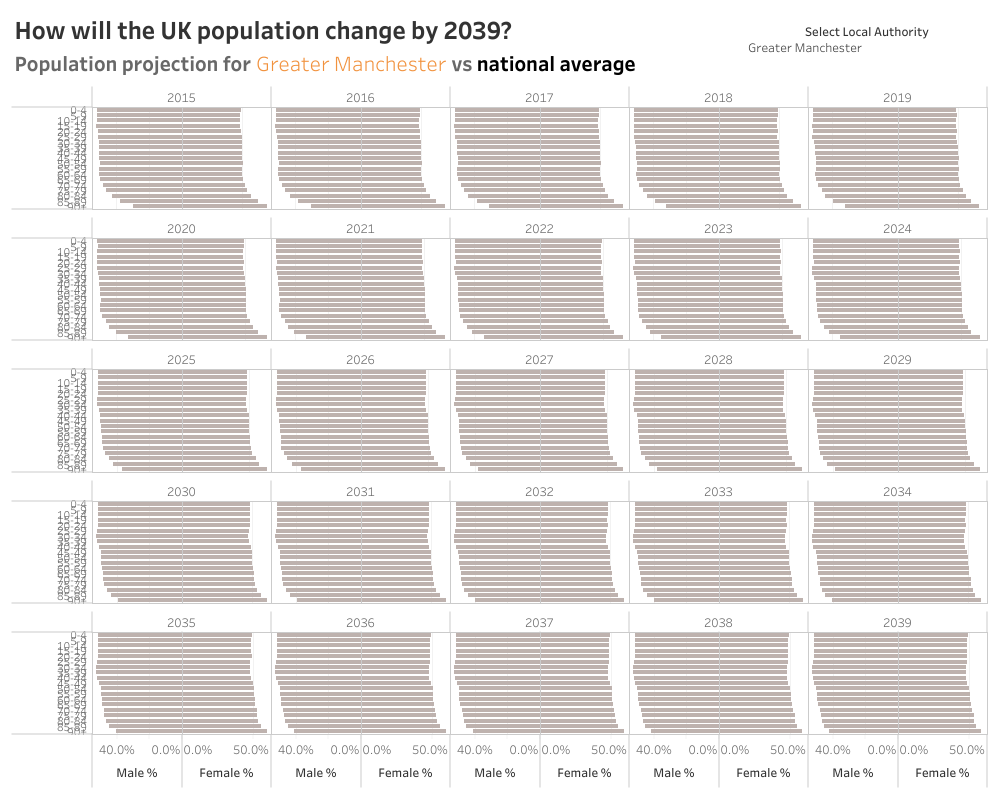
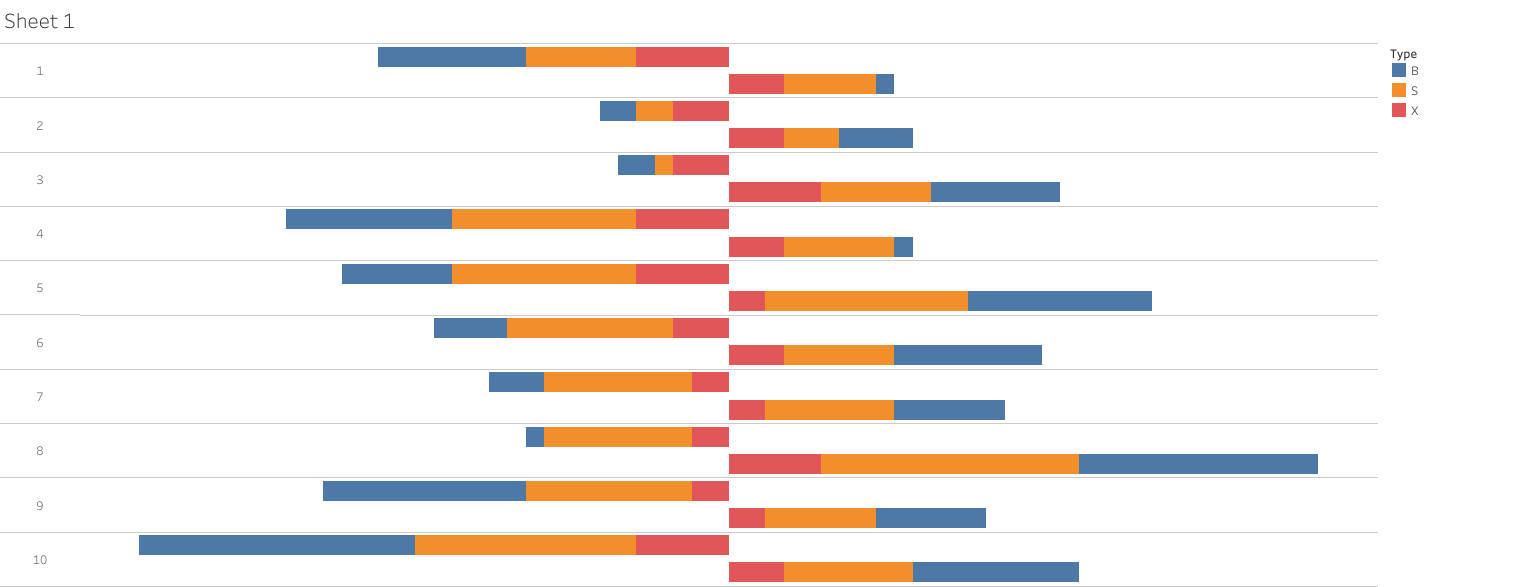
UK Population Predictions - Trellis Butterfly Chart: I put my newly-acquired LoD knowledge into practice here in order to separate the % of males and the % of females to create the butterfly chart. I'd never built my own Trellis before so I had to give up there and look it up afterwards: basically, create a field for columns using (index()-1)%(int(SQRT(size()))) and another for rows with int((Index()-1)/ (int(sqrt(size())))), drop them in as discrete values and compute each using the field we want in each cell. It's just one of those things you have to know, I guess, even if it doesn't make much sense...
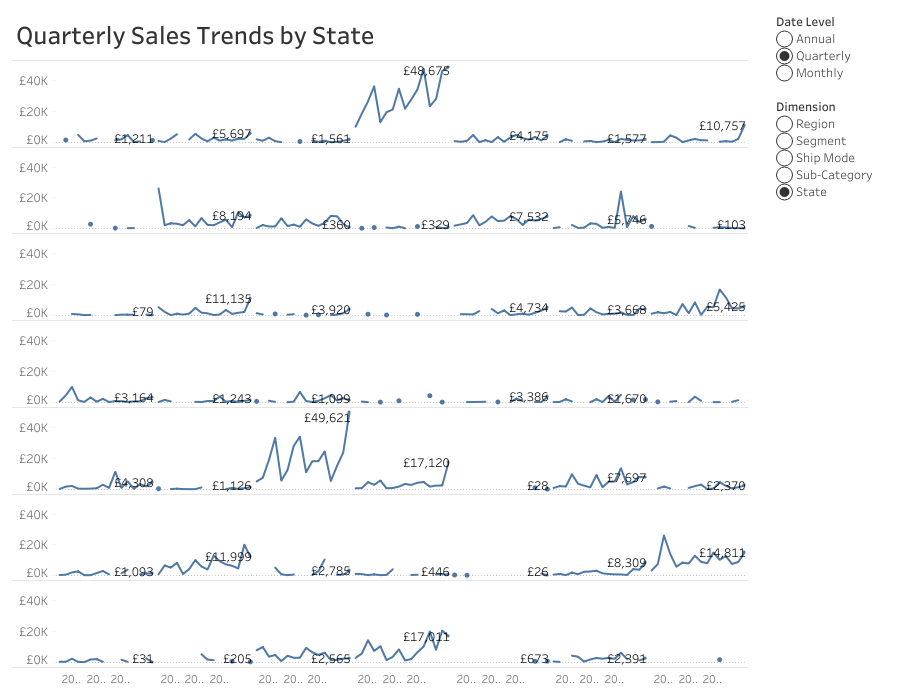
Dynamic Trellis Chart: that Trellis trick paid off here! I also used a parameter as the basis for a dynamic title, although there was much that I missed out on this one too
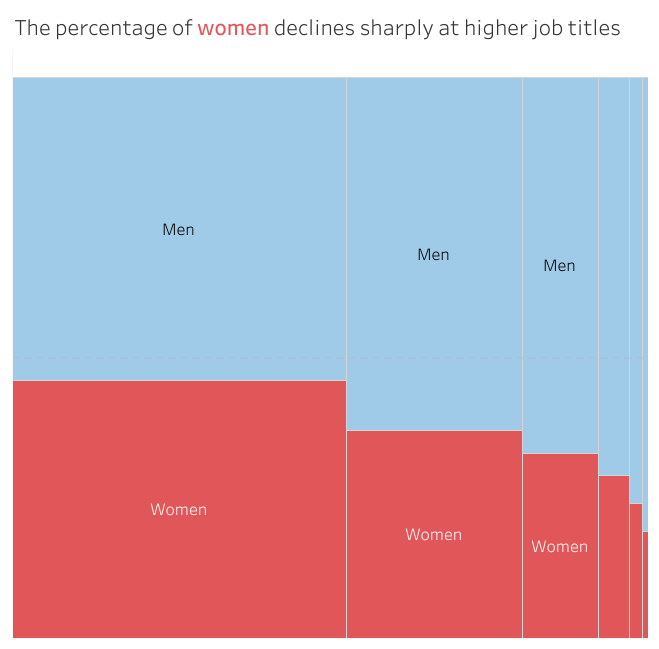
Merimekko Makeover: I learned how to build a Marimekko chart! This wasn't something I figured out through trial and error mind - I followed Jonathan Drummey's blogpost instead.
World Series Game 7: Pitch-By-Pitch: it was a struggle to know what I learned from this, which was definitely my worst attempt. Assigning a +1 or -1 to teams helped me to separate them out along the axis, but that's as far as I got. Yikes.
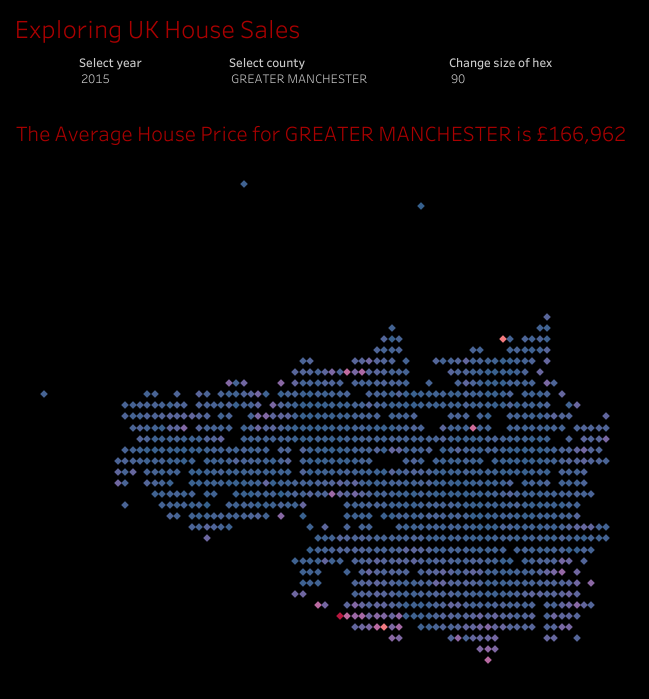
Exploring UK House Prices: I learned how to build a hex map by following the steps in this blogpost. Like the Trellis chart, this was an occasion where I didn't understand what I was doing, but doing it gave me the result I needed.
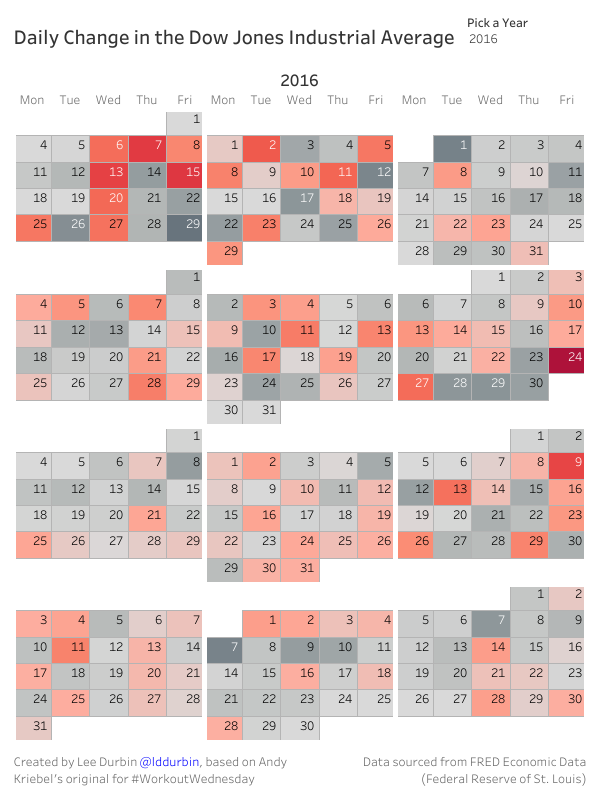
Full Year Calendar with Month Labels: another success by following a how-to guide, this time to create a calendar - only one step I couldn't quite fathom, which made for a refreshing change! I was really chuffed with the end result here, and it's surprisingly easy to achieve when you know how (isn't that always the way though?)
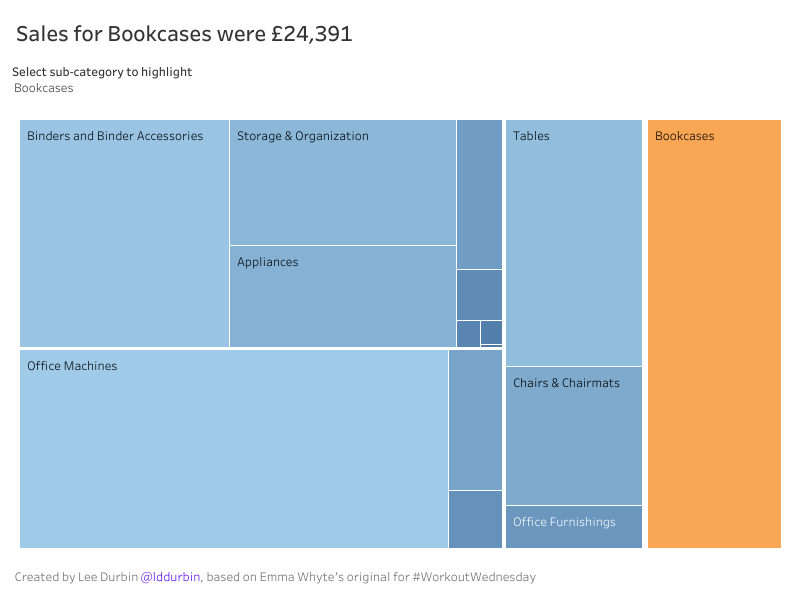
Highlight a Treemap: I think I learned that treemap logic is stranger than I'd realised. I learned that using a calculated field to check if a value equals the parameter selection is useful, but there was more to it than that. "More to it than that" probably sums up my Workout Wednesday experience so far!
What I learned about myself
Don't expect to know what you don't know: if I've never built a Trellis chart before, I'm not going to figure out how to do so by squinting at the data until I turn blue in the face. It's not a failure to look it up, nor is it a failure to look under the hood of Andy's/Emma's solution. That's what learning is all about: there's something you don't know, you learn about it from someone else, and then you apply what you've learned the next time it comes up.
It's ok to have a break: I set out to attempt one Workout Wednesday during each working day of the week. That was silly, as no-one's holding me to that schedule and it's unsustainable - not to mention counter-productive, because there were days when I only had half an hour for certain challenges that required an hour or two to crack. I've since stepped back from that expectation, and I'm aiming to do these often enough that I'll have caught up with the project sometime early next year, but not so frequently that I burn out after a week
Document your learning: each time I completed a challenge, I tweeted about what I learned (and, increasingly, what I needed to learn). I couldn't have written this blog post without those tweets, and this post is important for my future self - keeping a record of things I've picked up along the way is useful, especially if it's about techniques that I'm not using every day. And who knows, maybe someone else will benefit from this too?
Be kind to yourself: Mike Cisneros wrote a lovely thread on Twitter about the value of sharing. In a nutshell, he recommends putting your work out there even if it doesn't seem that important to you, and that resonated with me (hence my point above). At the core of his message though, there was something about self-care: be kind to yourself, and value your skills even if they seem insignificant to you. This is something I have to remind myself repeatedly because I suffer a lot from low self-esteem, and it's especially important to remember this when I struggle with a challenge and have to leave it unfinished. Ultimately it doesn't matter in a project such as this, because my progress isn't measured by my ability to perfect an isolated challenge - it's about what I've gained from the totality of the process. And, looking back at these twelve attempts, I'd say that I've gained a lot already. Here's to the next dozen challenges!