

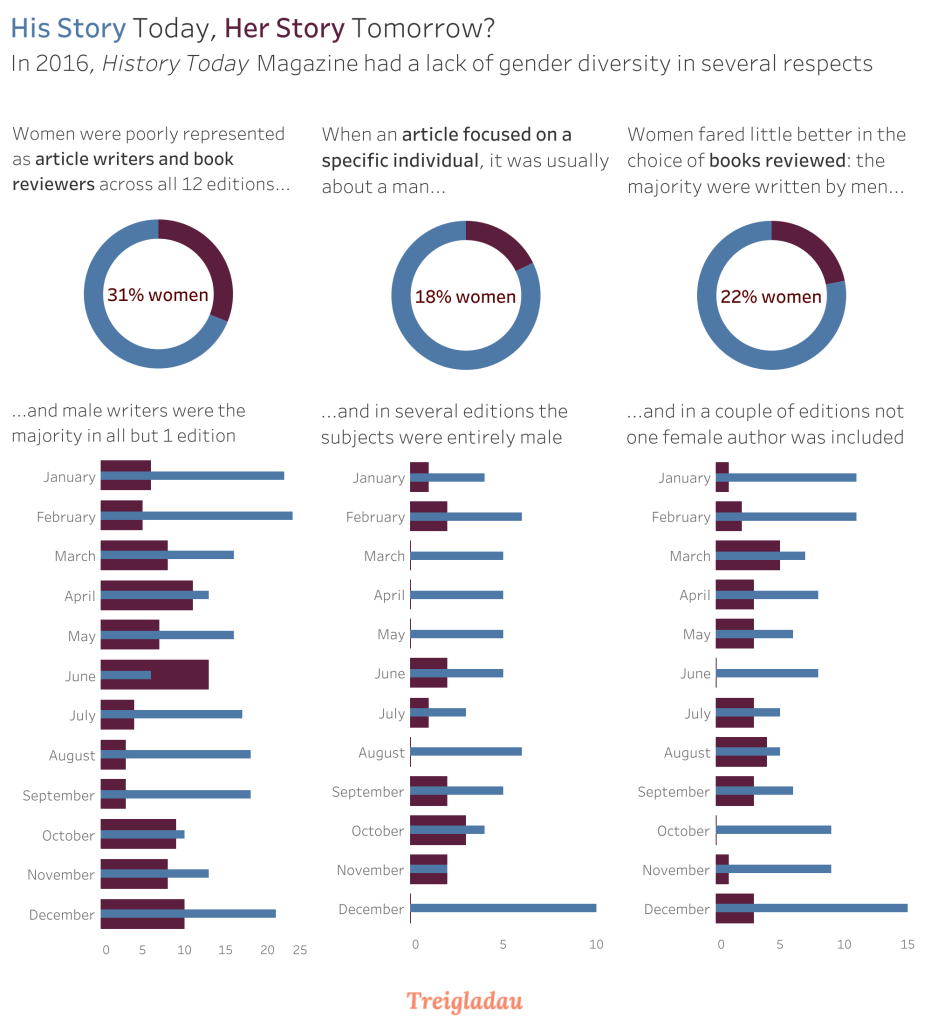
Click the image for a higher-res, interactive version. With thanks to Chris Love and Emma Whyte at The Information Lab for invaluable feedback.
UPDATE (23/12/2016): History Today published a response to this piece here, following a lively discussion that took place on Twitter, which I've tried to capture and comment on in this archived Storify
Cast your eyes over my above visualisation, and it's impossible not to conclude that History Today has struggled to present enough women's voices within its pages. It's a realisation that I had after browsing back through each edition of the magazine published in 2016, the first full calendar year of my subscription, and one that I felt it was necessary to share in a way that might be immediately understood.
It's been a while since I last posted to this blog (although I've been blogging elsewhere too), and during that time I've perhaps read less history than I would have liked to have done - although I have read every edition of History Today since I wrote about the January edition, and I still enjoy reading it just as much now as I did then. The articles cover a variety of subjects from all sorts of historical periods, which have enabled me to broaden my understanding of history on a regular basis in a way that I would otherwise not find the time for. That doesn't mean to say it's an infallible publication though, and it's with regard to the representation of women in the magazine's pages where I want to focus this post.
Recommending the men
In the December 2016 edition of the magazine, a number of historians were invited to recommend their favourite history books from 2016, and you can read about them here. Something that immediately struck me was just how few of these books were written by women - in fact, of the ten books recommended eight of them were authored by men, and the remaining two recommendations were the same book by the same woman. So eight out of nine in total - that didn't seem terribly representative to me, but perhaps this was an anomaly? I dug out last December's edition to compare: there were eleven recommendations last year (Tom Holland cheekily included two), but only three of these were of books written by women.
Eight out of nine, and three out of eleven - hardly a cause for celebration. Shortly after I published my last blog post about History Today, the Guardian asked a number of historians why they think history is still written mainly by men - you can read their responses here. Alexandra Harris contends that there isn't "any shortage of brilliant history being written by women, but more can be done to get people reading it", and it's for that reason that I began to wonder to what extent History Today was playing its part in that respect. After all, it claims on its website to "bring serious history to a wide audience", so why shouldn't such a wide audience expect to read as much about women as about men in articles authored by as many women as men?
Gathering the data
The act of collecting the data in order to produce the visualisation was difficult, and there were a number of choices I had to make. There were three categories that interested me, each involving various caveats::
- The number of women writing either an article or a book review
If more than a single individual wrote the article, then I would count it as having being written by a woman if at least one of the writers was a woman
- I excluded from this count regular features for which the same writer was always responsible, namely Richard Cavendish's Months Past, Eleanor Parker's Out of the Margins, Suzannah Lipscomb's Making History, Roger Hudson's In Focus, Kate Wiles's The Map, and Alexander Lee's Portrait of the Author as a Historian. I did, however, count the subjects of these articles where appropriate as defined below.
- I included the book reviewers in this count, as a brilliantly written book review would draw my attention to its writer inasmuch as a brilliantly written article would do the same. In some cases a book review was as lengthy as one of the less wordy features (e.g.History Matters), so it seemed silly not to include the reviewers here
The number of women being written about where an article primarily focused on a named individual
- This one is somewhat subjective, but I would consider an article to have had a primary focus on a named individual where either the title or sub-heading of the article named that individual, or where it was clear that the thrust of the piece concerned a single individual
The number of books reviewed that were written by women
- If more than a single individual was associated with the book then I counted it as though a woman had written it if she was either the co-author, co-editor, or translator of the volume
My methodology involved writing down the names of each of these writers or subjects across all 12 editions from January to December 2016, verifying the gender where that wasn't clear to me, and marking which of them was female. I transferred this to a spreadsheet, which formed the basis of the visualisation that you see above.
Whilst I have tried as much as possible to record this information in a fair and accurate fashion, I accept that some of my decisions might be argued one way or the other. I also accept that there could be faults in the data, but I'm willing to correct them where they're pointed out to me. I am reasonably certain, however, that the conclusion will remain unchanged even where errors in the data might be uncovered: women's voices are simply not present enough within the pages of History Today.
What's the big deal anyway?
The choices made by History Today's editors about whose work is featured in the magazine is important, as it enables these historians to draw attention to their work in advance of a publication, or to develop ideas in preparation for a more extended piece. The magazine's choice of books to review is also important, as these recommendations will no doubt guide the purchasing choices of many readers of both popular and academic history. Finally, the decisions made about which historical subjects to include within the magazine's pages influence the kinds of stories that are proliferated. On that final point, whilst decisions about which subjects are covered are admittedly beyond the control of the magazine's editors, there is nevertheless a strong correlation between the gender of the writer and their chosen subject, so in a publication dominated by male historians it's no wonder that the stories told are mostly about men as well.
In short, the choices made about who writes the magazine's articles and which books are reviewed have a profound influence on the range of voices that are most prominent within the historical community. Moreover, when it's usually men who are writing the articles it can be seen that it's men who are being written about, and that sadly limits the number of stories about women that can be told.
None of this is meant to vilify History Today, its staff, or its contributors - like I said to begin with, I thoroughly enjoy reading the magazine and will continue to do so throughout 2017. I don't doubt either that efforts are made to include women's voices as much as possible, but when I glance at that visualisation and see that fewer than a third of its articles and book reviews in 2016 were written by women, that in nearly half of its editions not a single woman was featured in an article as a primary subject, and that in two editions every single book reviewed was authored by men, I can't help but feel as though much more ought to be done here. Here's hoping for better in 2017.