

Will AI Do to Code What CAD Did to Drafting?
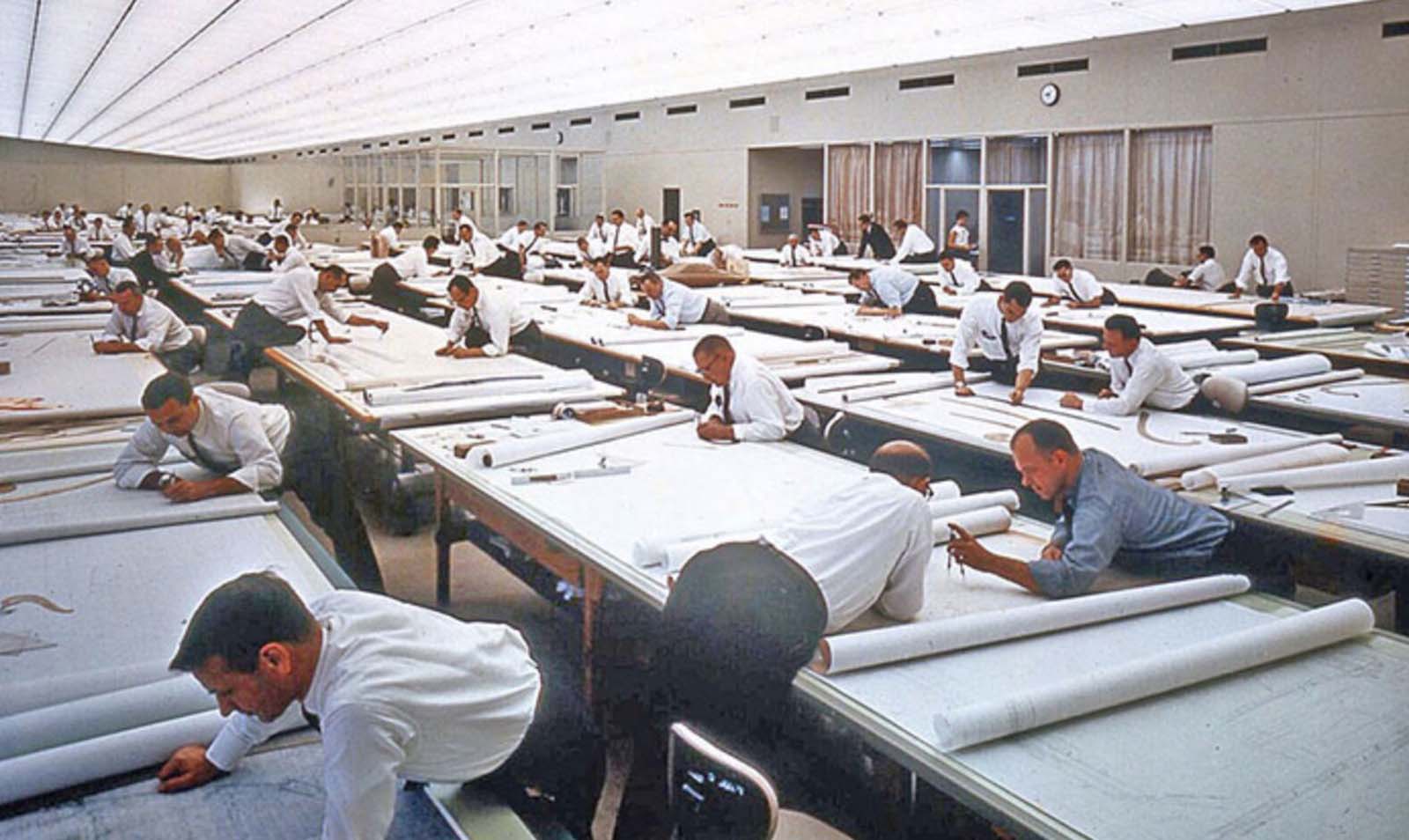
There's something remarkable about these photos of drafters from previous decades. Here's one of the drawing room at General Motors Technical Center in Warren, Michigan:
And another, supposedly of Tamron Industries, Inc.'s drafting department in the late 1970s:
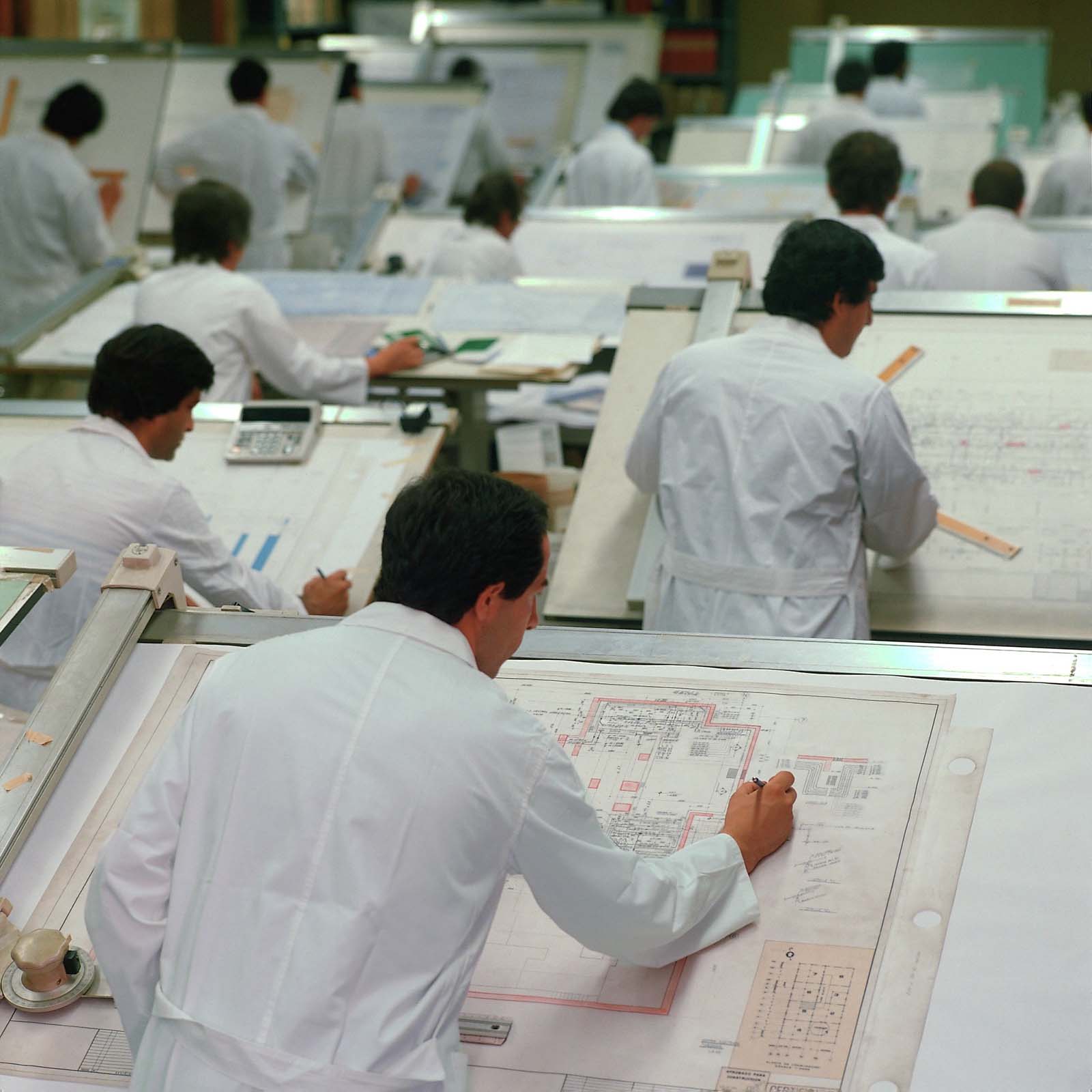
Until the late 1980s, the tools of most drafters were pencils, pens, compasses, rulers, protractors, and triangles. This allowed them to make detailed technical drawings by hand, typically for machinery, buildings, electronics, infrastructure and so forth.
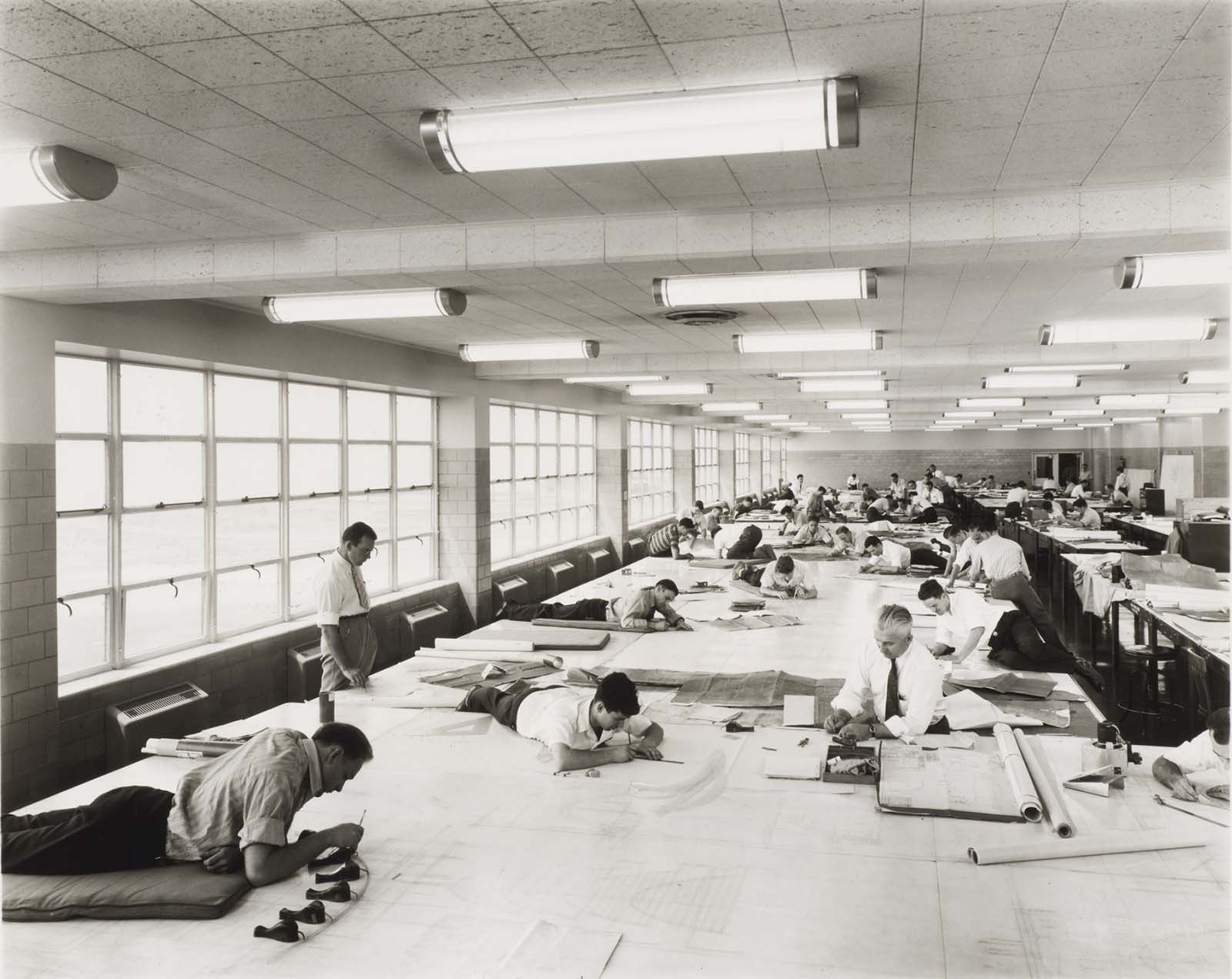
What strikes me about these photos of drafters at work is the pride in workmanship you see at play - these men (and they were overwhelmingly men) look deeply engaged in their work. You can also see the physicality of the work - bodies stretched across tables, or standing upright, or in the case of the image below of draftsmen at Albert Kahn's office in Michigan in 1942, of bodies sprawled across the very canvas they're working on:
This way of working had been refined over centuries. Within a generation, almost all of it would be gone.
By the end of the 1980s, CAD — computer-aided design — had transformed the profession, and there were clear advantages to companies who used computers to produce these designs:
These systems were marketed predominately on the basis that they could reduce current operating costs. If you had a drafting department with 20 drafters, buy one of these systems, run it around the clock and you could get the same amount of work done with perhaps 10 or 12 people. In some cases, productivity improvements were truly spectacular, especially within organizations that did a lot of repetitive work.
But like all technological revolutions, the transition from technical drawings painstakingly rendered by hand to computer-generated equivalents faced some resistance - especially from those who may have spent their careers sharing their hard-earned knowledge on the old techniques:
I remember having regular arguments with my tutors as to the rights and wrongs of CAD as opposed to traditional hand drawn methods.
Many of them just couldn’t grasp the concept that the computer was just a tool to replace the pen, not the Architect, and a 3D model built inside a computer was every bit as valid as one glued together with cardboard and plastic!
One tutor actually went so far as to flatly refuse to acknowledge the work I’d done with CAD because I “hadn’t done it myself“, in his words!!
-- Andy Bevan
Sounds familiar? It does to me.
For a long time I felt guilty about building with AI, simply because it didn't feel like "real" software engineering - like I wasn't doing it myself. As someone who took pride in my ability to write clear, concise R code I struggled with the idea of building something without wrestling with gnarly coding problems.
I'm sure I'm not the only one who has felt this way, and it's not helped by the sorts of comments I've heard about how only true software engineers can build quality products with AI, and that the rest of us (even those of us who've worked in tech for years and can write perfectly good code ourselves) are merely churning out AI slop.
Having spent the last year building with AI, I can safely say that hand-coding the things I've built with Claude would have been a total waste of time. Coming back to the world of drafters and CAD, I think this sums it up for me:
I clearly remember one homework assignment in structural engineering in the late 1950s. The problem was a fairly straightforward two-story building – perhaps three by four bays. Working with simply a pad of paper and a slide rule, the assignment took most of a weekend. I didn’t learn much about structural design but it did sharpen my arithmetic skills. Today, a student with a notebook computer can work on a building ten times as large and learn much more about what makes for a good design by trying different size structural members and different arrangements of these components.
So what actually happened to the drafters? They didn't disappear, but the profession transformed beyond recognition.
The craft of hand-drawing was absorbed into a higher-level discipline. Engineers stopped being people who made drawings and became people who made decisions that software translated into drawings.
Drawings became a byproduct. The output remained ubiquitous - we still need technical drawings for everything we build - but the human relationship to that output changed completely. Engineers moved up the abstraction stack: from draftsmen to CAD operators to systems thinkers and requirement definers.
This is where I think coding is headed. And what it feels like, from the inside, is this: learning through iteration is the key advantage of delegating coding tasks to AI.
When you write every line of code, even aided with a co-pilot, then you're allowing less time to review the output of your work, compare it to your expectations (or, better still, the expectations of your customers), and make changes accordingly. The feedback cycle is inevitably slower when you're knee-deep in debugging.
In the space of just three months, I've cycled through eighty-nine releases of Myndarin. At first that was in response to my own judgement as I used the product, but increasingly those releases are responses to user feedback. Try operating at that velocity as a solo developer when you write the code yourself.
And here's the thing that struck me most in researching this piece: it's happening again. To CAD itself.
There are now tools that generate 3D models from text prompts. Generative design systems where you set constraints—materials, load requirements, manufacturing methods—and the software produces optimised solutions. In Autodesk's 2024 survey, 76% of industry leaders said they trust AI to enhance their work.
The engineers who absorbed the draftsmen are now facing their own abstraction layer. The ladder keeps going up.
I don't know exactly what this means for coders, or for CAD operators, or for whatever comes next. But I keep thinking about those photos. The draftsmen knew what good looked like. That knowledge didn't become worthless when CAD arrived. It became the thing that mattered most.