

Note: this is the second part of my series of reflections as I progress through the 12 Days to Deming course. You can find Part 1 here.
Imagine you’re one of 6 people tasked with a job: pick up a small paddle with 50 indentations, dip it into a box of beads (some red beads, more white beads) and retract it, with a bead now in each of the indentations. The objective here is to only collect white beads.
Two inspectors independently count the number of red beads on your paddle, and a record is made of this. Afterwards, a foreman makes some observations about your results.
“You collected 11 red beads”, they say. “This isn’t a good start. You need to try harder next time.”
This goes on over three iterations. At the end of the third iteration, the foreman has had enough.
“You’ve always collected at least 9 red beads”, they observe sternly. “You’re fired.”
This is a real scenario, and it’s played out hundreds, perhaps even thousands of times. This is Deming’s famous Red Beads Experiment, and it tells us many important things.
Management as theatre
All the world’s a stage,And all the men and women merely playersShakespeare, As You Like It II.vii
I briefly introduced Dr Deming (and his mentor, Dr Shewhart) in an earlier blogpost. To begin to understand the significance of this experiment, watch the video below where Dr Deming himself conducts a group of volunteers through the process:
The first thing you might have noticed about Deming is that he’s funny.
“You understand gravity?” he asks his bemused volunteers after pouring the red beads from one container into another. “Gravity is dependable and cheap.”
It struck me that the whole thing is a kind of theatre. There are eleven players:
- The Foreman, here played by Deming
- Six Willing Workers lined up behind him
- The two Junior Inspectors, who independently count the red beads (bead counters, get it?)
- The Chief Inspector, who compares the results from the Junior Inspectors and announces the result
- The Recorder, who keeps track of the red bead count and provides a daily tally and a cumulative total.
The whole thing begins with a training session, kind of like a rehearsal for a performance. There’s a dry run, then the performance begins.
Deming is like a director, commenting on the performance as it proceeds, praising or critiquing as necessary. Towards the end, two of the players are taken offstage and the remaining four have to double up their parts.
But it’s all for nothing. The performance is dismal, and the curtain falls down on it all. The audience applauds, but what precisely are they clapping for?
It’s funny watching it all play out, but this is why I think the Red Bead Experiment is a tragedy as well as a farce: this also plays out every day in workplaces all over the world.
A System of Profound knowledge
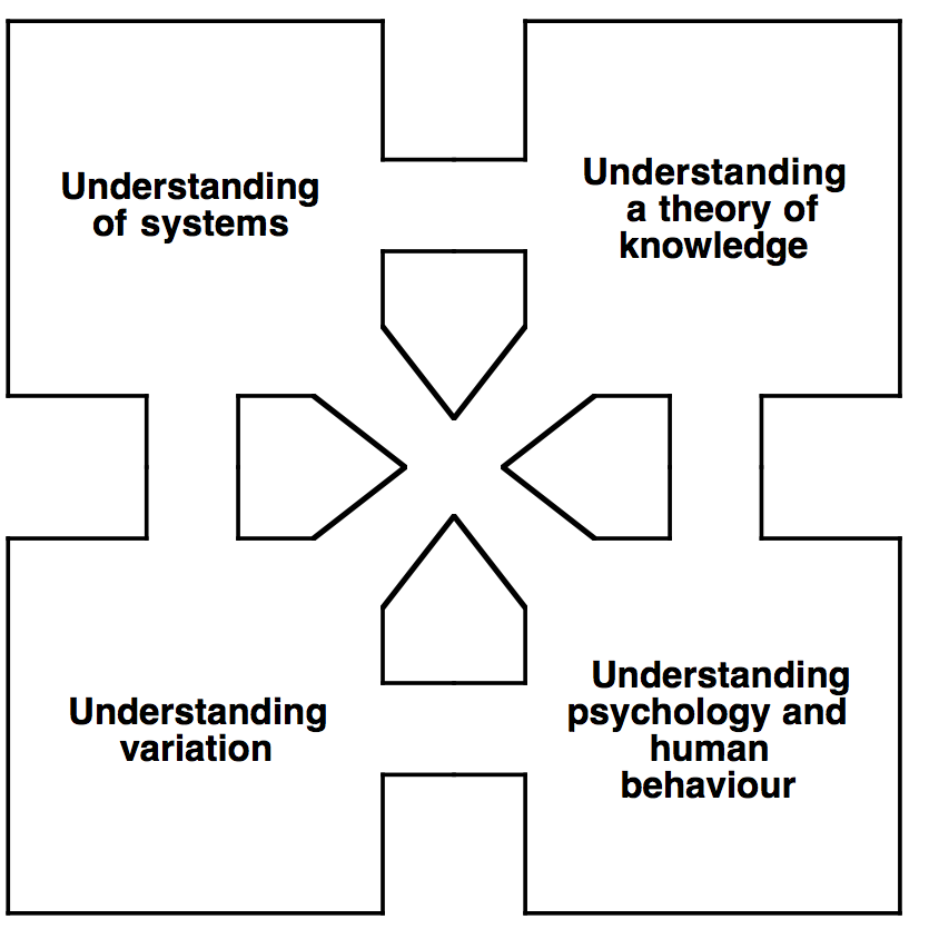
Deming was 89 years old when he began talking about a System of Profound Knowledge, as represented in the diagram above (produced by Peter Scholtes, a colleague of Deming’s). It comprises four major parts:
- Understanding of systems: the idea that an organisation is a system which consists of many components. The strength of such a system is how these components interlink, and how they help or hinder each other.
- Understanding variation: also the title of the greatest book about data I’ve ever read, this idea has its roots in Shewhart’s breakthrough in the 1920s. This component also stresses the importance of appreciating the difference between common cause variation and special cause variation.
- Understanding a theory of knowledge: epistemology, or in other words how do we know the things we know? How do we learn things? How do we improve that learning and knowledge?
- Understanding psychology and human behaviour: this one is self-explanatory, but reinforces my observation that Deming’s philosophy was a humanistic one. People were at the heart of his teaching.
The wonderful thing about the Red Beads Experiment is that all four of these are on display, and reflecting on how they’re on display helps us to learn some important lessons from the experiment.
Understanding of systems
The above diagram illustrates how the four components of the System of Profound knowledge are interlinked, which reminds us they form a system (the clue’s in the name). The Red Beads Experiment is a farce because the output of the workers is determined not by their performance but by the system itself, and the system is rigged against them.
No matter what the foreman says, the fact remains that the container of beads includes red beads, and that’s not a people problem but a systems problem.
Understanding variation
The experiment is also a calculated display of how to measure and understand variation.
What I haven’t mentioned here and what you don’t see in the video is how the individual ‘scores’ (number of red beads per scoop) are plotted onto a run chart (or time-series chart). Subsequently, two values are calculated, the Upper Control Limit and Lower Control Limit (I won’t go into how these are calculated here).
Once you plot the UCL and LCL onto the run chart, you now have a control chart. If your points fall between these two lines on the chart then we can say that the process is in statistical control, and the fact that the time-series line wiggles up and down is simply due to common cause variation.
This point is crucial, especially when you appreciate that the foreman is behaving as if the different results produced by the willing workers is due to special cause variation.
Understanding a theory of knowledge
What do the willing workers know as they go about their work? They know what the foreman tells them and shows them.
What does the foreman know? He should know, observing as he does each scoop of the paddle, that the willing workers have little agency when it comes to improving performance. And yet on and on he goes, berating them or praising them depending on the number of red beads that appear quite randomly in the paddle.
What the foreman also probably knows is that someone put those red beads in there. The willing workers could probably figure that out too, but unlike the foreman they probably have little power to do anything about it.
After the third day the foreman removes two workers from the process, when instead he should remove 50 red beads. If that were to happen, what would everyone learn? They would learn, to quote Deming, that “quality is set at the top”.
Understanding psychology and human behaviour
We come to the final component of the System of Profound Knowledge as observed in the Red Beads Experiment. There’s much to say about human psychology and human behaviour here, but the point I want to make is best illustrated by an anecdote recounted by Dr Henry Neave in his 12 Days to Deming course:
I shall not forget an occasion when, as soon as the experiment had ended, one of my delegates stood up, ashen-faced and with unsteady voice, to confirm that so much of what had just happened, so much of what I (as the Foreman) had said to the workers, so much of the way I had mistreated and abused them, eventually firing some of them for no justifiable reason, had not only all happened to him but to others in his family.Dr Henry Neave, 12 Days to Deming (Day 2, p 28)
This is why I say that the Red Beads Experiment is a tragedy as well as a farce. Even in a situation that plays out as a kind of theatre, it retains echoes of the real tragedy that Deming spoke about in 1984 in relation to his own country, the USA:
With a storehouse of unemployed people—some willing to work, a lot of them willing to work, with skills, knowledge, willingness to work; and people in management unable to work through the merit system, annual rating of performance, not able to deliver what they’re capable of delivering. When you think of all the under-use, abuse, and misuse of the people of this country, this may be the world’s most underdeveloped nation. Number One—we did it again! We’re Number One … for underdevelopment. Our people not used, mismanaged, misused, and abused, and under-used by management that worships sacred cows: a style of management that was never right, but made good fortune for this country between 1950 and 1968 because the rest of the world, so much of it, was devastated. You couldn’t go wrong, no matter what you did.Those days are over, and they’ve been over a long time. It’s about time for American management to wake up!Dr W Edwards Deming, quoted in Neave, 12 Days to Deming (Day 1, pp 37-38)
Ironically, he said this the year I was born - which was also the year in which thousands of coal miners in the place where I was born (and elsewhere) went on strike to prevent the closure of what few colliers remained operational. After many months of strikes they admitted defeat. Most of them would lose their jobs in the months and years to come as the coal mines were closed one after the other.
Here's an excellent recent TED talk on the strikes in South Wales, where I was born and raised:
“Loss of market”, Deming wrote in his seminal work Out of the Crisis, “and resulting unemployment, are not foreordained. They are not inevitable. They are man-made.”
Survival is optional
I work in the public sector, where you might assume that the consequences for behaving the way the foreman does in the Red Beads Experiment are less severe than in the commercial world. But you’d be wrong, and not just because of the electoral repercussions borne by politicians when the public finally have enough of it. The consequences are also severe for those working within the system, often powerless to change it but forced to undergo their own version of the experiment.
The story of the 1984-85 strike illustrates this point, but here’s an example from my own career which is probably quite common to many data analysts. This is admittedly less consequential than the loss of thousands of jobs and the shattering of communities, but for those of us fortunate to be engaged in knowledge work it can help to connect our work to Deming's insights.
Part of my job has regularly involved pulling together data from across parts of the business I work in, and running a series of comparisons: this month vs last month, this year to date vs last year to date, the result vs the target and so forth.
What’s wrong with this? Nothing really, except for what comes next: I’m then asked to provide commentary on why the numbers have gone up or down. If you’ve stuck with me so far, then you’ll appreciate that I’m being asked to explain what is likely common cause variation as if it were special cause variation.
You’ll also appreciate how demoralising this is, because I know deep down that I’m mostly making things up, or else turning to someone else in the business who’s making up stuff on my behalf. What a waste of time, and what a waste of human potential.
“Survival is optional” said Deming. What I think he meant is that you don’t have to follow his advice, and it’s perfectly possible to find explanations for things which require none and react accordingly. In fact, most organisations do it most of the time, but given enough time they will (and do) fail.
In my line of business, that failure doesn’t just cost jobs but its can also damage communities. Part of my motivation for studying Deming is to promote better ways of working, and I hope that by sharing my learning journey here you’re beginning to see what I’m beginning to see.