

In my previous post on Deming's philosophy, I referred to a visual representation of his System of Profound knowledge. In this post we're going to look at what Dr Deming described as the five "Deadly Diseases" of Western Management by referring to the following diagram:
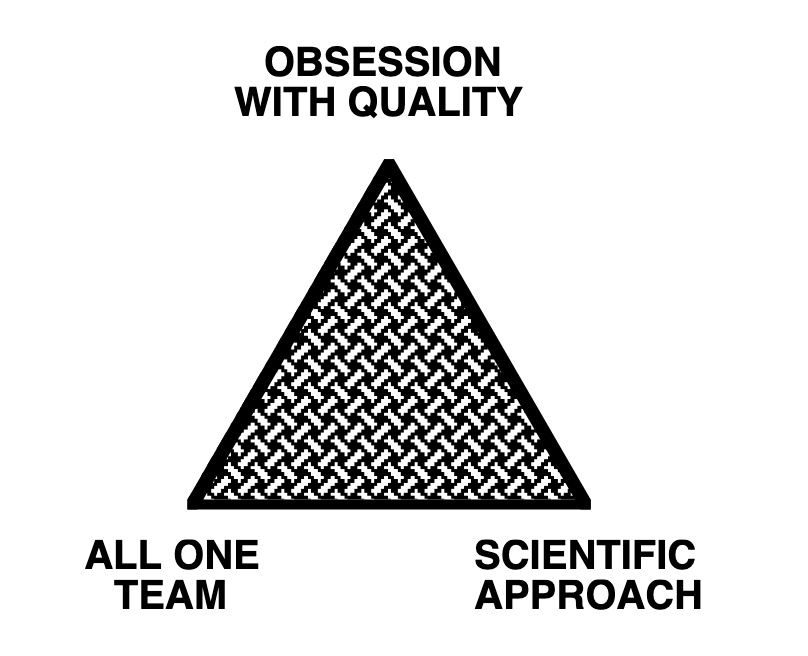
This is the Joiner Triangle. Like the previous diagram we saw, this summarises much of Dr Deming's philosophy into just a few words and, crucially, visually emphasises that they're interlinked. We're going to use this as a tool to deconstruct the Diseases.
Here's a brief summary of what each point of the triangle means:
- Scientific Approach: if you read my other post on Deming (the one about the Red Beads Experiment) then you'll be familiar with this idea, which focuses on the need to address the system. A scientific approach allows us to identifying the systemic issues at work, and helps to guide us towards a correct course of action.
- All One Team: this is self-explanatory and is the one that most organisations espouse in principle even if they fail at it in practice. This is about more than simply working together, it's about cooperation rather than competition between teams, it's about working across functions and hierarchies, and it's about optimising for the entire system.
- Obsession With Quality: few would deny the importance of quality to succeed in business, but many place limitations on the extent to which they will pursue this. An obsession signals that this is a way of life, a relentless drive to improve even when there's no immediate need to do so. As Dr Henry Neave puts it: "if it's broke, fix it; if it ain't broke, improve it."
Each Disease covered below is accompanied by a quote from Dr Deming describing the nature of the Disease, followed by my own commentary these the three dimensions of the Joiner Triangle: Obsession with Quality, All One Team, and Scientific Approach.
As I work in data and my career has been spent in mission-driven organisations (universities, nonprofits, and local government), we're going to examine the five Diseases from that angle.
Disease 1: Lack of constancy
The crippling disease is lack of constancy of purpose to stay in business by planning to provide product and service in the future that will help man to live better materially, and which will have a market, and provide jobs.
>
>
Obsession With Quality
This Disease sounds like it’s only applicable to for-profit enterprises - after all, government entities often have monopolies on products and services that aren’t at all cost-effective for businesses to offer. But inefficient processes have diminished the quality of public sector products and services to the point where they lose what’s most important for a healthy society: trust in institutions.
The political chaos of the last decade or so shows what happens when societies lose trust in institutions who they feel are no longer serving their best interests. In those circumstances, the public will turn to alternatives who make empty promises, hence the rise in populism.
If anything, a lack of constancy in the public sector has far graver consequences than in other organisations.
All One Team
In the public sector we should serve all our constituents, irrespective of political affiliation, class, religion, sexuality, race, or anything else. One possible route to a lack of constancy within a public sector institution is when we forget who we serve, perhaps focusing on one constituency over another, or failing to address communities of greatest need.
Scientific Approach
Understanding variation is the key to productive innovation. If we don’t know where we’re falling short and how to change the system, how can we adapt to changing market forces? If we optimise based on the whims of top management then we’re flailing, especially as top management is rarely in place for more than a few years at a time. Rooting our constancy of purpose in a scientific method transcends personalities.
Disease 2. Short-termism
Short-term thinking defeats constancy of purpose to stay in business with long-term growth.
>
>
Obsession With Quality
Short-termism is one of the reasons why training is more common then education in most organisations - the latter takes far more time away from the job than the former. But a transformation of management requires a transformation of mindsets that doesn’t come about via a 3-day offsite. Understanding why obsessing over quality is so important requires a level of understanding that isn’t brought about by mastering a set of skills, but through profound reflection that takes time.
All One Team
If an incoming government doesn’t believe they’ll win the next election, then why would they risk starting a project for which their political opponents may take the credit? A One Team perspective would compel different behaviour, a kind of selflessness for which politicians are not well known.
Scientific Approach
A scientist who draws conclusions based on the first evidence they collect is liable to draw incorrect conclusions. In the same way, results can only be understood over time and efforts should be directed toward long-term improvements that require a different set of metrics from those that track changes quarter-by-quarter. This longer-term scientific approach also opens up a space for considering the unknown and unknowable metrics which we’re not used to tracking.
Disease 3. Appraisal of performance
The effects of performance appraisal (personal review system, merit rating, evaluation of performance, annual review, system of reward, pay for performance, etc) are devastating.
>
>
Obsession With Quality
We can’t fix quality by fixing the individual. What’s sometimes perceived as an obsession with quality is instead an obsession with attributing personal blame - especially if that blame can be directed outward away from management to the worker. And can we really say we’re obsessed with quality if we limit ourselves to helping our people just once a year during the annual appraisal?
All One Team
Nothing creates an us vs them environment more than the annual appraisal. The Office captured this brilliantly:
There’s not much I can add to that.
Scientific Approach
What’s scientific about pressuring individuals into justifying their role in the organisation, especially when they’re powerless to change the things that prevent them from doing their best work and taking pride in their workmanship? A scientific approach would recognise where the fault lies in the system, and would empower individuals to make the necessary changes and do good work - and to do this continuously, not once a year.
Disease 4. Management job-hopping
Mobility of management causes instability, results in decisions being made by people who do not know the business and thus blindly use experience gained elsewhere which may be totally irrelevant.
>
>
Obsession With Quality
Job-hopping managers will optimise for the short term, which compromises long-term value for short-term gains that they hope will reflect well on their tenure.
There is a paradox here though: if lots of workplaces suffer from the Deadly Diseases, this often creates a hostile environment for the kinds of people who might want to adhere to good practice, and upon discovering this and trying (and failing) to change the system, it’s in the interests of their own wellbeing that they move on. In fact, an obsession with quality implies that they should move on - if quality can’t be improved in one workplace, it makes sense that they should search for a place where it can.
All One Team
Team culture is difficult to foster when managers are constantly changing, a little like Defense Against the Dark Arts teachers.
It also creates a reputation for that team - don’t manage them if you want an easy life! The team is unlikely to focus on longer-term aims if they think that priorities will change as soon as a new manager comes on board, which they inevitably will in short order.
Scientific Approach
It’s difficult to take a scientific approach without sufficient knowledge of the business. A bit like a doctor needs years of study and practice before they’re qualified, changing aspects of the business are at risk of misfiring unless their effects are understood.
As Deming notes, it can take years to develop this understanding, but that doesn’t limit a manager to one role - in fact, occasionally moving to other roles within the organisation should be encouraged. In my case I spent 3 years as a Senior Data Analyst before taking on management responsibilities for that same team for 9 months, and then after another brief stint in my old role I moved into a Product Owner role in a more central team. I still don’t fully understand the business.
Disease 5. Use of only visible figures
One can not be successful on visible figures alone. Of course, visible figures are important: the bank account must be watched, and employees and vendors must be paid. But he who would run his company on visible figures alone will in time have neither company nor figures.
>
>
Obsession With Quality
This Disease resonates with me a lot.
When I used to work in university fundraising, the only number that really mattered to top management was the money we raised - not even the money in the bank account, but also everything that was promised to us because that would give us the highest number (after all, we had a fundraising campaign target to hit). Lip service was paid to things like donor retention, satisfaction, and so on - but even our surveys were really seen as a tool for identifying donors, not primarily as a means for understanding our alumni! It was simply easier to count the money because we had to, and because it was what the Vice Chancellor cared about.
All One Team
The kinds of numbers that top management are interested in are usually different to what more junior staff are interested in, and this is also influenced by different perspectives across generations. Many of us where I previously worked were passionate about the donor experience and donor retention, whereas top management’s performance was judged on how much money they brought in, so that was their primary focus (which, not coincidentally, influenced how they thought we should be counting the money). This can create a divide between different tiers of a team or an organisation, which is anathema to the All One Team approach.
Scientific Approach
There’s nothing scientific about only measuring what’s visible, or what’s easy to measure. The great leaps in quantum physics wouldn’t have occurred if science took such an approach, and more such leaps might be seen in industry if greater effort was put into unconventional measures - this is one of the reasons why data science is often seen as a cost as opposed to a benefit to the organisation, not because of the sophistication of the techniques but because of the choice of the measures. This calls for a human-centred approach that will inform the sorts of measures that can strengthen data science work, without which we’re not maximising the extent of the insight we can provide.