
In 2017 I was hired as the first Insights Manager at the Donkey Sanctuary.
Yes, the Donkey Sanctuary.
To imagine what it was like working there, picture a farm in the English countryside with rolling hills just a stone’s throw away from the coast. Hundreds of people visit the site every day to see all kinds of donkeys cared for by the staff and volunteers, and the air is punctuated by the braying and neighing of the herds.
My office was in what used to be the veterinary centre for the donkeys, and my desk overlooked the paddock housing the poitou donkeys. Here’s a picture of me and a poitou donkey. They’re big.
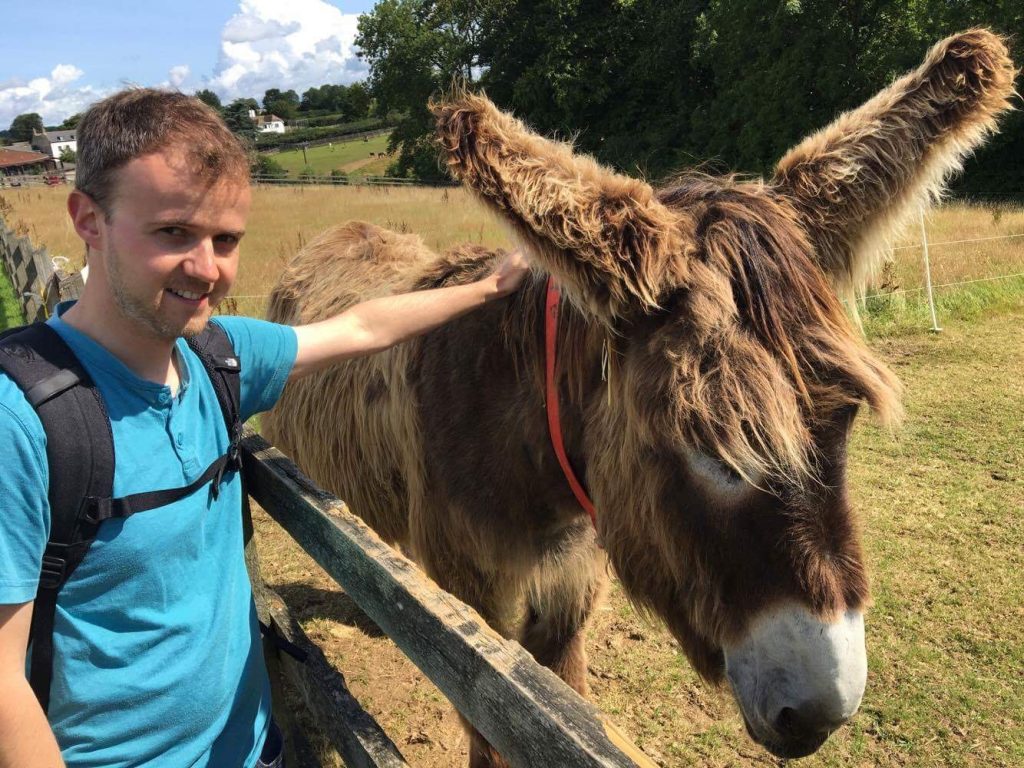
As part of my induction I got to spend a day looking after a donkey, and I spent my lunch breaks walking around the site patting the various donkeys. So yeah, it was a pretty magical place to work and if you’re ever the visiting the south-west of England I recommend you check it out - it’s free to visit!
But what has this got to do with data? Well, here are some numbers for you.
- The Donkey Sanctuary cares for over 2,000 donkeys across its UK sites. Its headquarters is based near Sidmouth in Devon, England, where you can visit the 200 resident donkeys there - including some you can adopt for a small donation.
- Speaking of donations, the Donkey Sanctuary is a registered charity, and benefits from around 60 million pounds per year in donations and legacy bequests.
- The Donkey Sanctuary is a popular tourist attraction, visited by over 400,000 people a year. They have a shop and even a restaurant on site, with all proceeds going towards the benefit of the donkeys. They run a lucrative commercial operation, bringing in about 3 million pounds a year across their onsite, online, and mail order activities. I recently bought some donkey-themed socks, and I brought my beloved donkey lap tray with me when I moved to New Zealand.
When I was hired as the Insights Manager, I was responsible for analysing this sort of data, spanning across the fundraising, commercial, and comms departments. I only stayed for about a year before I moved across the world to live here in New Zealand, but during that time I learned three important things about working as an early data hire in a mission-driven company that I think are worth sharing.
Now although I’m going to talk about my experiences as an early data hire at a mission-driven organisation, much of what I’m about to say is applicable if you’re an early data hire at any organisation. If that organisation is just starting out on its data maturity journey, then these three things are essential to know.
So let’s get into it.
Be helpful
If you work for a mission-driven company, whether that’s a nonprofit or a public sector organisation, most of the people you work with probably don’t care a lot about data, and are more likely to care about the mission itself. This is true irrespective of where the organisation finds itself on its data maturity journey, but it s especially true if data isn’t a core part of its strategy.
The mission might involve serving a community, caring for animals, educating the next generation, or any number of other noble causes, and as much as it might be obvious to you that the success of this mission rests on good data, that’s going to be less obvious to your colleagues.
Here’s what I’ve learned over the years: lecturing sceptical colleagues about the importance of data doesn’t work.
And when you take a step back it makes sense: why should they take the time to understand what’s important to you before you’ve taken the time to understand what’s important to them?
In my role at the Donkey Sanctuary I wasn’t working with data about donkeys, I was working with data about the people who supported our work, whether through donations, bequests, purchases, or simply engaging with our content. It was important that I understood who our supporters were, why they supported us, and how we were connecting with them. This interest in the Sanctuary’s supporters was what drove my approach.
Here’s what happened: we were due to increase the price of our donkey adoption scheme and we wanted to tailor the messaging about this based on the adopter’s profile, but it was impossible to segment the data in the way we needed using the database we had. So I introduced a data wrangling tool into the organisation called Alteryx, created a data pipeline using a mirror of the database, and passed the customer IDs by segment back to the CRM team to export the customer details accordingly.
This was an important move because it built trust with key stakeholders within the organisation. It showed that we could work with data differently to achieve our goals and deliver value to our supporters. It also saved heaps of time, and it was repeatable; this last point was important because we needed to communicate with the adopters in waves depending on their adoption renewal dates, and because their information was changing all the time the same segmentation would need to be run every month.
Until I delivered this piece of work I wasn’t getting much traction with my colleagues. They were using spreadsheets and VBA macros, but the only person who understood how the macros worked was the person who built them, and the Excel data wrangling was time-consuming and error-prone. Once they saw how a tool like Alteryx could achieve things that weren’t possible with their existing solutions in a fraction of the time, they were much more open to what I had to say.
So, make sure you understand what it is about the mission that your colleagues value. Then, determine how you can make a valuable contribution in that space using your skills as a data practitioner. You’ll earn their trust, and you’ll be given greater license to do more.
Be flexible
If you’re one of the first or even the first data hire at a mission-driven organisation, then you probably won’t be limited to working in the areas outlined in your job description.
This may come as a shock to you, and it doesn’t usually happen because your employer misled you but instead because they simply don’t know what they don’t know.
There was this trend during the 2010s of enterprises hiring data scientists to mine Big Data for a competitive edge, but as soon as these whizz kids with PhDs turned up they realised that either the data they needed wasn’t available, or it was in a such a mess that they spent more time working as data engineers than data scientists.
You’ll probably find yourself in a similar situation if you’re one of the first data hires at a mission-driven organisation. If they hired you as a data analyst, the chances are you’ll need to spend more time wrangling data that analysing it, and just as much time persuading your colleagues that they ought to be working with data differently, as we’ve already discussed.
When I was interviewed for the job at the Donkey Sanctuary, they explained to me why they needed an Insights Manager. The Sanctuary was founded in 1969 by Elisabeth Svendsen, and she had guided the charity throughout its existence nearly right up to when she passed away in 2011 at the age of 81. Subsequently, the organisation could no longer depend on the intuition of its charismatic founder and wanted instead to be guided by the data.
Like those data scientists who found themselves working as data engineers, I quickly realised that I couldn’t derive insights from the data because it either wasn’t available or it wasn’t accessible. Sometimes I didn’t even know where it was in the first place, which is why I had to spend lots of my time when I started just getting to know people.
All this is to say that you shouldn’t feel duped as a new data hire in an organisation that’s new to data if you’re not working on what you expected to be working on. If that’s the case, embrace the opportunity to use a different sort of skillset, and think of your job description as a place to get to as opposed to a starting point.
Be patient
If the organisation you’ve been hired into is early in its data maturity journey, then that means some time has passed during which it was operating without efficiently using data. In other words, habits have formed over years or even decades that may be diametrically opposed to the way you think things ought to be done.
Newsflash: those habits aren’t going to change overnight.
We’ve already talked about how important it is to understand and deliver value early, as well as the need to be flexible with your skillset, and those things will serve you well. But human beings are naturally resistant to change, and with all the best will in the world you are not going to change the company’s data culture overnight. You might not see significant progress for months or even years into your tenure, and it’s important to accept this fact early on so you don’t get frustrated - because your colleagues will pick up on that, and it’s going to hurt your cause.
As important as it is to be patient with the process, that patience will need to be extended towards the people you’re working with. Very few people are going to understand what you’re talking about to begin with, even if it seems obvious to you. Even when they do, that doesn’t mean they’ll immediately start working with data differently. And even when they start working with data differently, there’s a high chance that they’ll slip back into their old ways when things get tough.
Change isn’t sudden, and it isn’t linear. Some weeks will feel like progress, whereas others will feel like failures. Don’t measure your progress in weeks but in months: ask yourself six months in, am I making a difference here? And then ask that same question six months later.
If you have the support of senior leaders, if you’re able to demonstrate value early on, if you remain flexible, and if you’re patient, then you’ve given yourself the best possible chance of success. I only worked at the Donkey Sanctuary for about a year, but I can look back at my time there and feel confident that I did make a difference, that I showed a different way of working with data and there were people who got it.
This is how data maturity progresses: incrementally. If you’re a lone voice trying to advance data maturity at your organisation, I hope this post has given you some ideas for how to move forward. Believe me, I know how hard it can be - but you’ve got this!